It’s the morning of Tuesday 6th June, 1944. Operation Overlord, the Allied invasion of Normandy, is underway. Sometime between 0730 and 0800, taking their turn in the assault waves, flotillas of landing craft are closing on Sword beach carrying the men of 4 Commando.
Among the array of vessels hitting the beach that morning are Landing Craft Infantry (Small), embarking 177 Free French troops under the command of Commander Philippe Kieffer.
LCI(S) class landing craft
The Landing Craft Infantry (Small) or LCI(S) were British-built modified Fairmile Type H boats, born out of the hard lessons and losses of raids such as Dieppe and St Nazaire. The prefabricated wooden design of the Fairmile H type meant boats could be produced in a variety of yards, but they just weren’t robust enough.
General characteristics
These modified boats were protected by extra steel armour plating which was applied to the deck sides, gun positions, generator house, forward bulkhead, and deck. Increased protection meant loaded displacement rose to around 110 tons. Typically armed with a pair of 20mm Oerlikon guns and two or more .303 Lewis guns, the LCI(S) held a crew of 2 officers and 15 men with accommodation. Below deck was room for 6 officers and 96 fully equipped men.
Carrying pennant numbers from 501-600 they saw active service during the Normandy landings and Walcheren operations.
LCI(S) at Sword
During D-Day, 4 Commando landed onto Sword beach by LCA whereas the attached French commandos were carried ashore by two LCI(S) of 201 LCI(S) Flotilla:
LCI(S) 527 (LTIN 190) was commanded by Temporary Lieutenant Craven and carried No.1 Troop.
LCI(S) 523 (LTIN 191) was commanded by Temporary Sub-Lieutenant Berry and carried No.8 Troop.
HQ and Vickers K-Gun sections were split between the two landing craft.
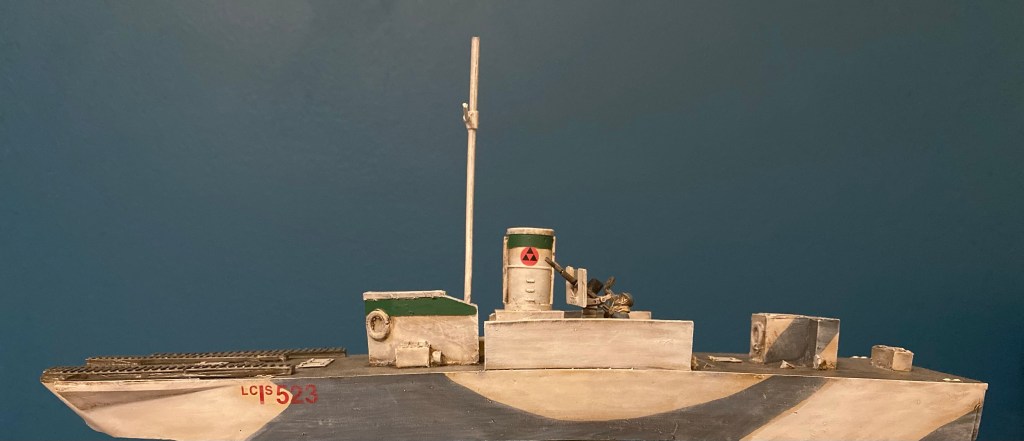
By 0750 both of these boats have landed on the far eastern flank of Queen Red sector of Sword beach. 523 has taken damage close to shore but has landed all personnel.
Once ashore, the French Commando mission was to clear the Riva-Bella defences and then advance through enemy territory in order to link-up with the British forces of 6th Airborne holding the Orne bridgehead.
More on what happened next will come in a later post on Casino de Ouistreham. But if you’re interested, both 523 and 527 survived the day. Due to damage sustained during the landings, 523 was taken in tow by 527 back to the UK.
This boat, 523, is the inspiration for my model.
What’s available in 20mm?
As I needed an LCI(S) for my planned Sword game, I shopped around to find out what my options were in 20mm. The four options I considered were:
- Sentry Models/Raventhorpe
- Britannia from Grubby’s Tanks
- Scratch build. Check out the brilliant work of scratch-building a pair of LCI(S) on the JP Wargaming Place blog.
- 3D print.
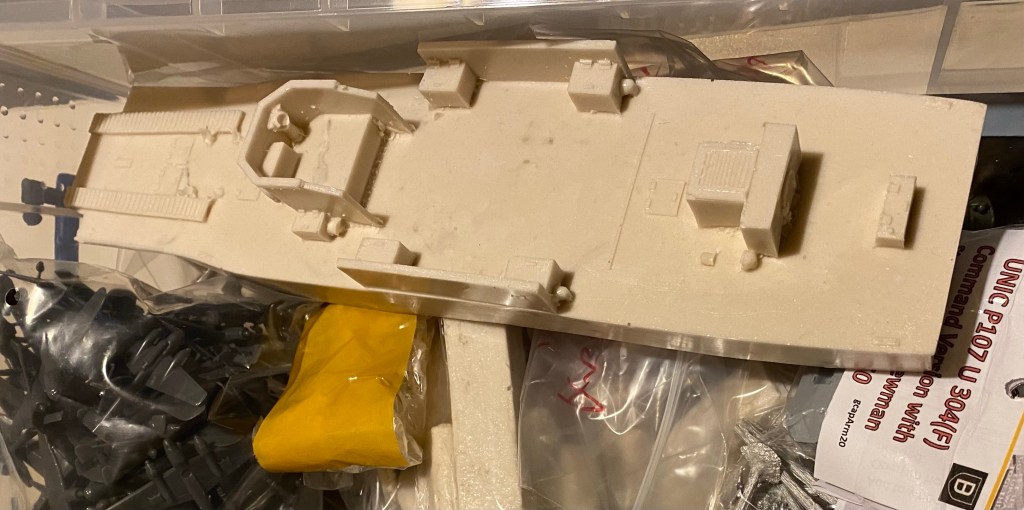
For a number of reasons I went for the Britannia model, and collected it at Colours from Andy Grubb – great service as always. The Raventhorpe looks good too, so I think it’s really down to personal choice. At the time I didn’t have a 3D printer, and I wasn’t up for the challenge of a scratch build!
My LCI(S) 523
After the usual preparation for a resin model including filling holes, I followed the same paint scheme I’d put together for my LCAs with some adjustments for the LCI(S).
Step 1: Undercoated with Halfords Grey Primer spray-can.
Step 2: Basecoat of Halfords White.
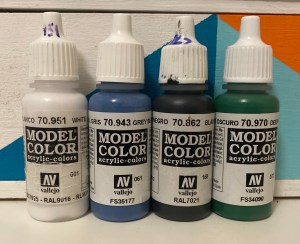
Step 3: Camouflage pattern brush painted using Vallejo 70.943 Grey Blue.
Step 4: Deck painted with Vallejo 70.862 Black Grey.
Step 5: Applied Army Painter Strong Tone Wash over whole model.
Step 6: Drybrushed white areas with Vallejo 70.951 White, deck with a mix of Vallejo Black Grey with a hint of white, and camouflage areas Vallejo Grey Blue with around 20% white.
Step 7: Painted Sword beach identification band with Vallejo 70.970 Deep Green.
I then undertook some detailing and added decals for pennant numbers on hull sides and aft, along with 3rd Infantry Division insignia on both funnel sides.

Now I need to paint a Commando Troop so I have some troops to land from it…!
 WARGAME DESPATCHES
My u cle was on LSI(S) 531. Any information would be appreciated
LikeLike
Hi Tom thanks for your note, I’ll check the information I have and get back to you. Cheers
LikeLike