The Loyd Carrier (with only one L!) was a light armoured vehicle used by the British Army during the Second World War. It was a versatile tracked vehicle designed for transporting infantry and supporting combat operations, for example by towing anti-tank guns.
Featured image photo credit: © IWM B 7425.
DEVELOPMENT OF THE LOYD CARRIER
In the late 1930s a British engineer, Vivian Loyd, aimed to create a versatile, affordable and adaptable vehicle suitable for a range of military operations. Inspired by the Carden-Loyd tankettes, the result was the Loyd Carrier.
A prototype vehicle was tested by the British in late 1939 and an initial order for 200 vehicles followed shortly afterwards. By the end of production in 1944 a total of around 26,000 of all versions had been built by a number of manufacturers, including Ford and Wolsley.
Widely employed by British and Commonwealth forces throughout the Second World War in all main theatres of war, Loyd carriers are perhaps most commonly thought of as tracked towing vehicles within infantry battalions. In the post-war period Loyd Carriers also found use employed by Belgian, Danish and Dutch armed forces, with some soldiering on into the 1960s.
ROLES AND VARIANTS OF THE LOYD CARRIER
There weren’t many differences between variants, these mainly being seating arrangement and armour plate location.
Personnel Carrier: Equipped with a front bench seat and seating for troops on the track guards. Frontal and full side armour fitted.
Towing 2 pounder and 6 pounder guns: Equipped with four single seats and ammunition stowage on the track guards, this Loyd Carrier was used for towing the 2 pounder and 6 pounder anti-tank guns. This was the main variant by number of vehicles manufactured. In this role the Loyd was capable of towing the 6 pounder but lacked space for both crew and ammunition. This was overcome by providing two Loyds per gun. The second Loyd carried ammunition and the separate blast shields, which were usually attached to the sides.
Towing 4.2″ mortar: Crew and some shells were carried on the Loyd, whereas the mortar, equipment, and further shells were stowed in a trailer towed behind.
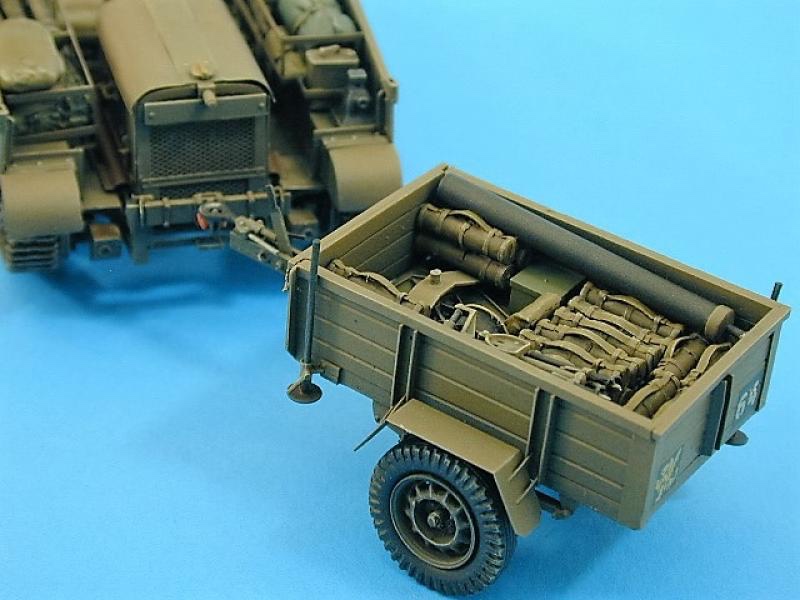
Cable Laying: A vehicle for Royal Corps of Signals work, 200 Loyds were built as mechanical cable layers with no armour fitted. A mechanical cable layer was mounted in the centre of the vehicle and a variety of cables and other paraphernalia was stowed on the front and sides. In time this was superseded by a version of the Universal Carrier.
Starting and Charging: Loyd Carriers with dynamos and large batteries fitted were issued to armoured formations in order to jump start armoured vehicles with flat batteries and to recharge batteries. No armour was fitted to this version.
OPERATIONAL USE
Loyd Carriers returned to France with the British Army in 1944, with examples coming ashore on each of the British beaches during the Normandy landings of 6th June. Thereafter they took part in all of the major operations in which the British and Canadians were engaged through the Normandy campaign and across North West Europe. While perhaps not as ubiquitous as the Universal Carrier, Loyd Carriers are a key part of representing a British force – especially infantry formations.
WHAT ARE MY OPTIONS IN 20MM?
We’re well catered for, with my favourite being the excellent Plastic Soldier Company (PSC) kit which comes with 6 pounder and crew. You also have options from Raventhorpe’s ‘Ready to Roll’ range and SHQ. Definitely worth mentioning are the range of variants available from Milicast, plus Early War Miniatures (EWM). Milicast and EWM both offer the GS trailer fitted for the 4.2 inch mortar. There are probably options from other manufacturers, and of course 3D printing.
BRINGING THE MODEL ALIVE
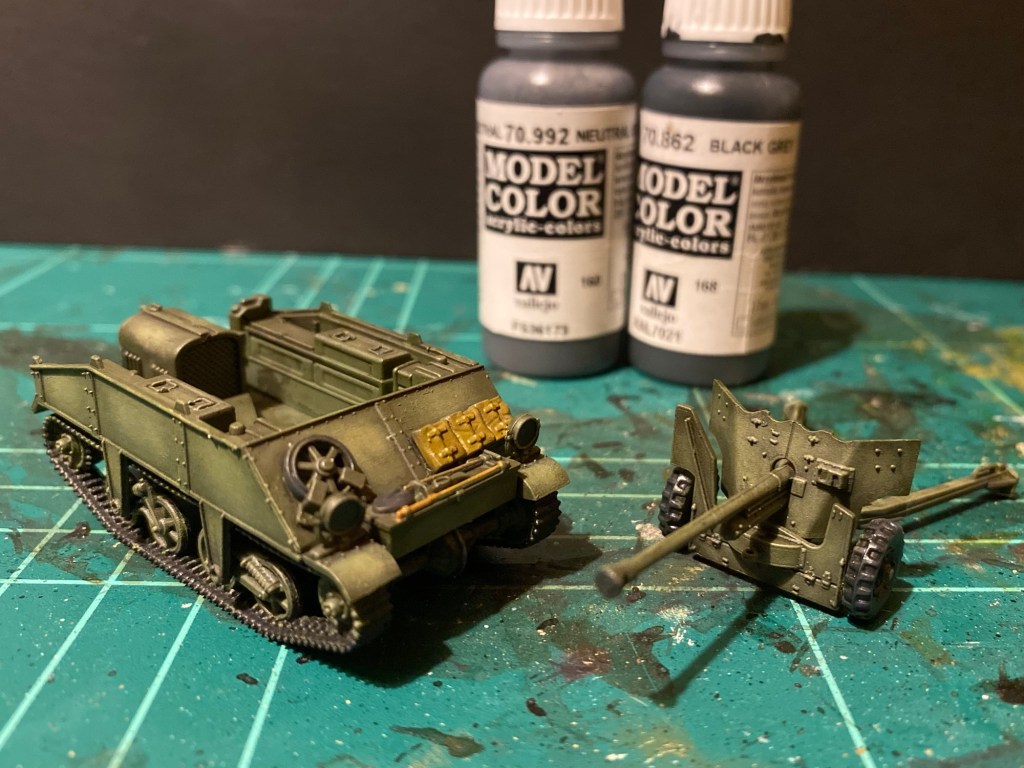
I’ve built a pair of PSC Loyd Carriers, one as a tow with 6 pounder gun and one as a towing vehicle for the 4.2 inch mortar. While not 100% accurate, I’ve built one of the Airfix GS trailers to represent one carrying the 4.2 inch mortar. In time I’ll upgrade it with the Milicast or EWM option. For now I have 6 of the Airfix Jeep kits in the stash, so have to start putting them to use! For painting I’ve used my now standard approach and recipe, you can read about it here in an earlier blog post.
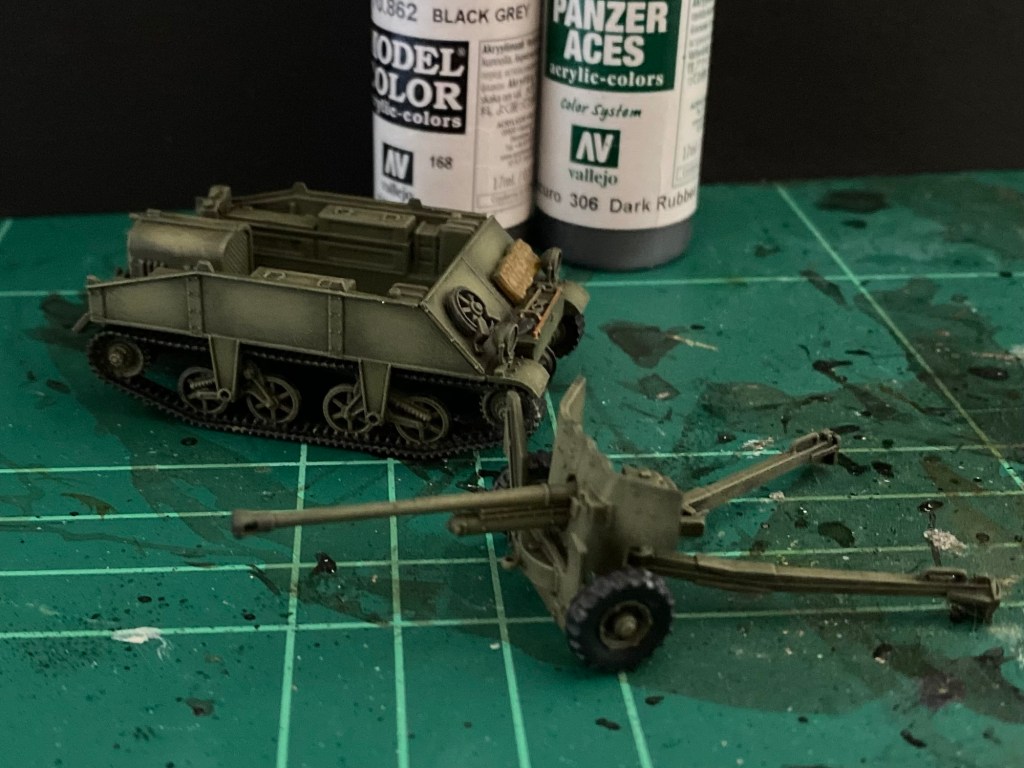
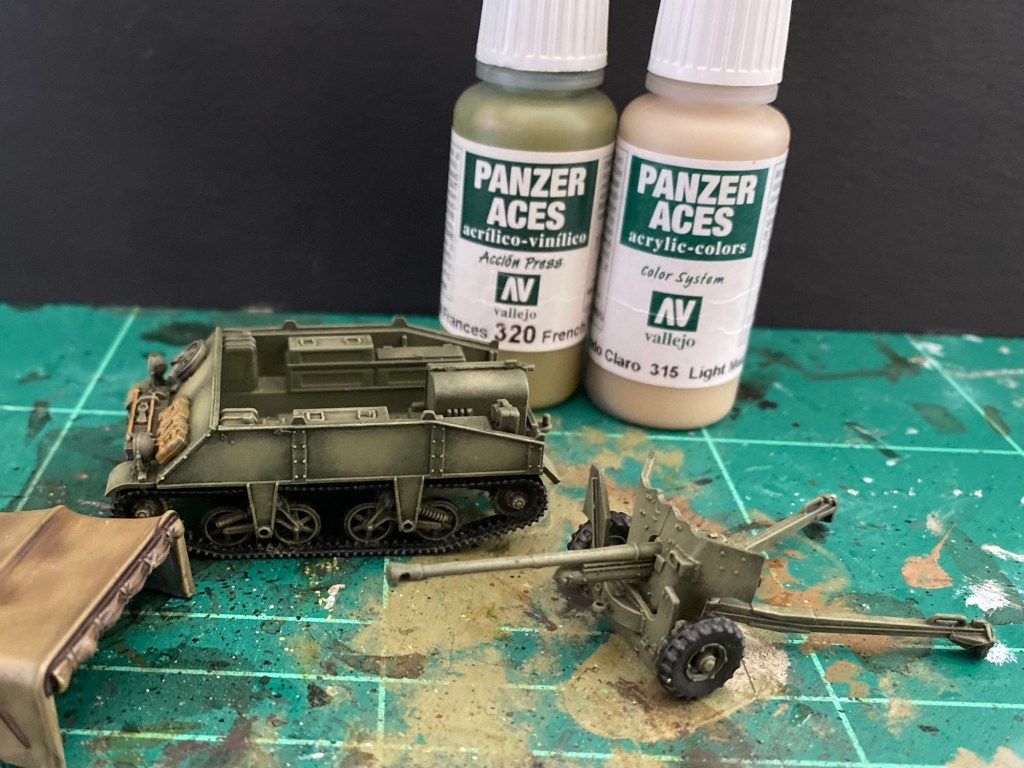

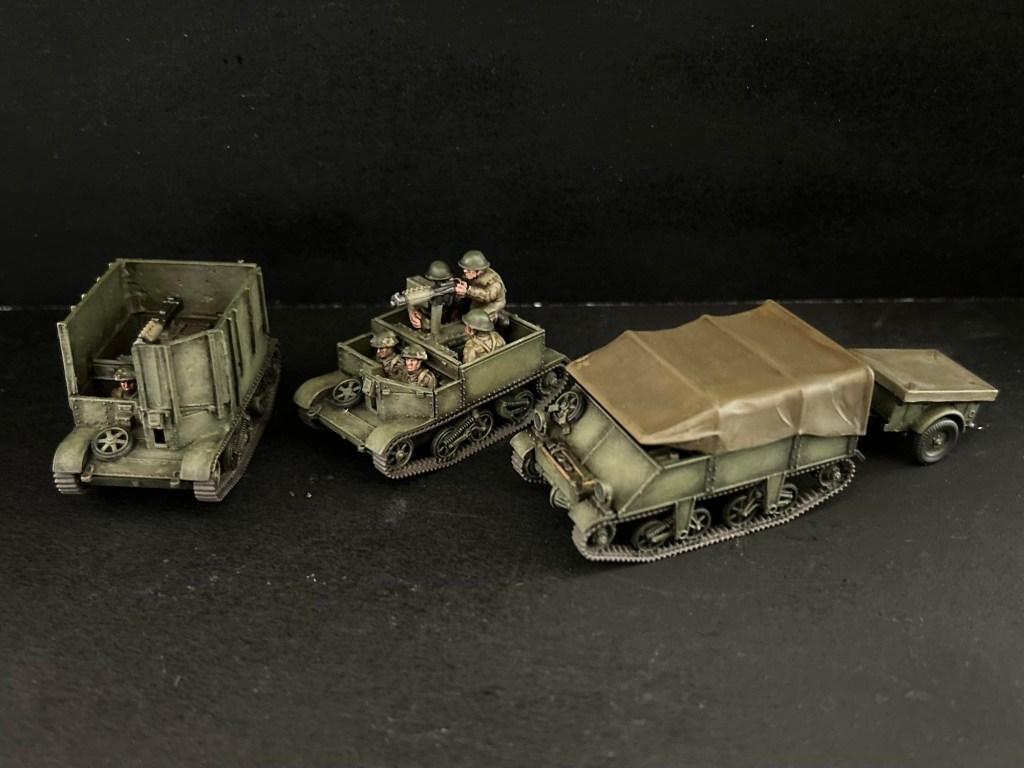
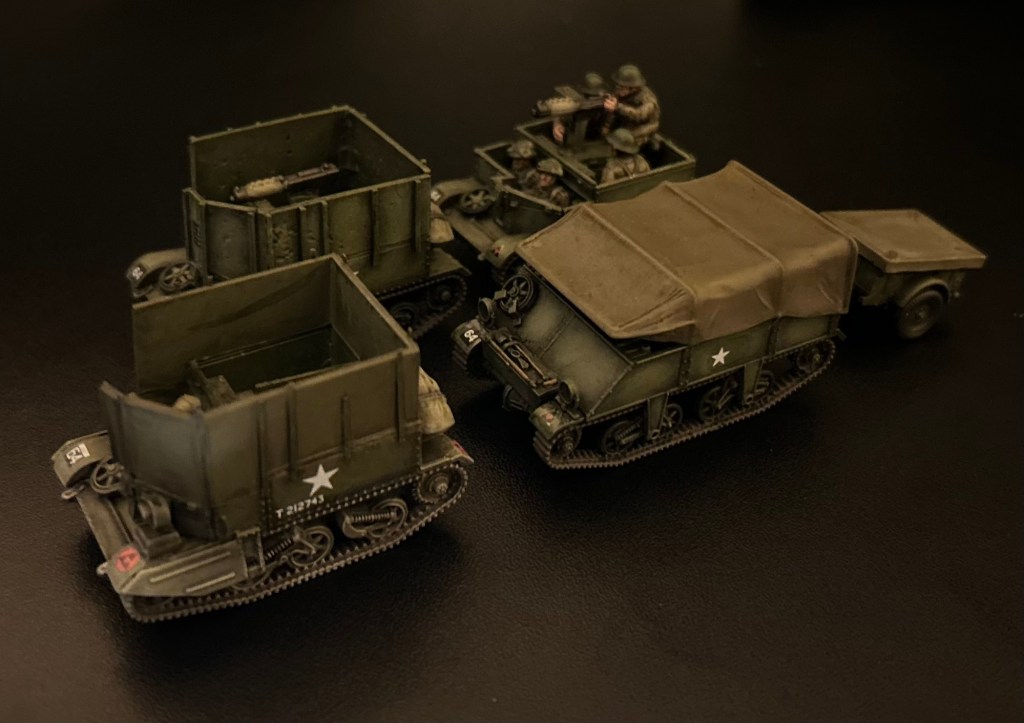
Decals always make a big difference to a finished model to my eye, and I’ve raided the decals box for these. I wanted to represent a Loyd Carrier for the 5th DCLI with 43rd Wessex Infantry Division which I could use for Hill 112 amongst other engagements, and a 4.2 inch mortar carrier to represent a mortar platoon of 2nd Middlesex for D-Day onwards.

These Loyds therefore carry Arm of Service (AoS) decals from the Dan Taylor Infantry Brigade and Sword Beach Vehicle sets, Wessex wyverns are from the PSC infantry division set, and Allied recognition stars are from various sets in the decals box. Once I’ve finished all the other British vehicles for Sword and Hill 112, I intend to weather them a little further around the decals to tie them all together.
WHAT’S NEXT?
So there we have a pair of Loyd Carriers ready for Normandy. Here’s a photo with all the vehicles for 2nd Middlesex, next will be deployed weapons and then they’ll be ready for hitting Sword beach and beyond.
 WARGAME DESPATCHES
They’re a smashing little vehicle. great kits from PSC and Millicast. Have you tried one from IBG models – also very nice little kits – although the tracks are testing. Tiny links not for the ham fisted!
Your painting is fantastic.
LikeLike
Thanks for your kind comments! I’ve not yet tried the IBG one, that might be a step beyond my skills for now!
LikeLike
Oooh, very nice Dave! 🙂 I like them with the canopy in place! I’ve got a 3D print from Butlers Printed Models and it’s a nice model but doesn’t have the canopy.
LikeLike
Thanks John! Yes I prefer the tilts/canopies in place too, it makes for much easier painting 😉
LikeLiked by 1 person